

A neti pot is a small, teapot-shaped device used to rinse your sinuses out with a saline solution, flushing mucus, allergens, whatever’s irritating your nose, out one nostril and out the other. Been around for centuries in traditional practice. These days doctors recommend it pretty routinely, congestion, allergies, sinus infections, the usual suspects.
Here’s the one thing worth knowing before anything else, though, and honestly it matters more than everything else in this guide put together: the CDC has linked plain tap water in neti pots to a small number of rare but fatal brain infections. An amoeba that survives just fine in untreated tap water, apparently. Not common, to be clear. But completely avoidable once you know what water to actually use, which we’ll get into properly in a second. This guide covers the full setup, mixing the saline itself, how often to rinse, using one with a deviated septum, cleaning, and the benefits and side effects people actually run into along the way.
Quick note before diving in. This is general education, not a stand-in for real medical advice, especially if you’ve got ongoing sinus issues, a weakened immune system, or any doubts at all about whether this is the right move for you.This guide is part of our growing Health & Wellness series — if you’re also figuring out your inhaler technique, we’ve got a full step-by-step guide for that too.
How to Use a Neti Pot: Step-by-Step
The motion’s simple once you’ve done it a couple times. First attempt, though? Usually feels a little awkward. That’s normal, don’t overthink it.
Step 1: Mix your saline solution.
Right water, covered properly just below, don’t skip ahead, mixed with the saline packet that came with your pot. Or a homemade mix if that’s the route you’re going.
Step 2: Lean over a sink.
Head tilted forward and to one side, roughly 45 degrees, looking down into the sink. Not straight ahead like you’re brushing your teeth.
Step 3: Insert the spout into your upper nostril.
Gentle seal, whichever nostril’s higher given the tilt.
Step 4: Breathe through your mouth and pour.
Tip the pot, let it flow in. Angle’s right, it travels through on its own and comes out the lower nostril. No sucking, no forcing. Just gravity.
Step 5: Repeat on the other side.
About half the solution’s gone, blow your nose gently, switch the tilt, do the second nostril.
The short version, for anyone skimming:
Right water, lean and tilt, pour in the top nostril, let it drain out the bottom, switch sides.
What Is a Neti Pot and How Does It Work?
Runs on basic gravity, really, plus the fact that your nasal passages actually connect to each other. Not separate dead-end tunnels, which is what a lot of people assume going in. Pour saline in one nostril, head tilted right, and it travels across, comes out the other side, carrying mucus and dust and pollen and whatever else along with it.
Doctors call this nasal irrigation. Neti pots are just one way to do it, alongside squeeze bottles and the powered systems. Saline matters more than you’d think, too, plain water alone can actually sting, irritate the inside of your nose, since it’s not balanced to match your body’s own fluids the way a proper mix is.
Types of Nasal Irrigation Devices (Neti Pot vs. Squeeze Bottle)
Neti pots aren’t the only option here, and which one you end up with really just comes down to preference, not any meaningful performance gap.
Classic neti pot runs entirely on gravity, tilt and pour, nothing to squeeze at all.
Squeeze bottle, NeilMed’s the name most people know, uses gentle hand pressure instead, and some find that easier to control, a bit less messy the first few tries.
There’s also powered irrigation systems that pulse the saline through automatically, usually the priciest by a good margin, probably overkill unless you’re rinsing daily for something chronic. None of these actually outperform the others for an occasional sinus rinse, honestly, so whichever one feels least intimidating is the right pick.
The One Rule That Actually Matters: Never Use Tap Water
Single most important thing in this whole guide. More important than technique, timing, anything else here. Worth saying twice.
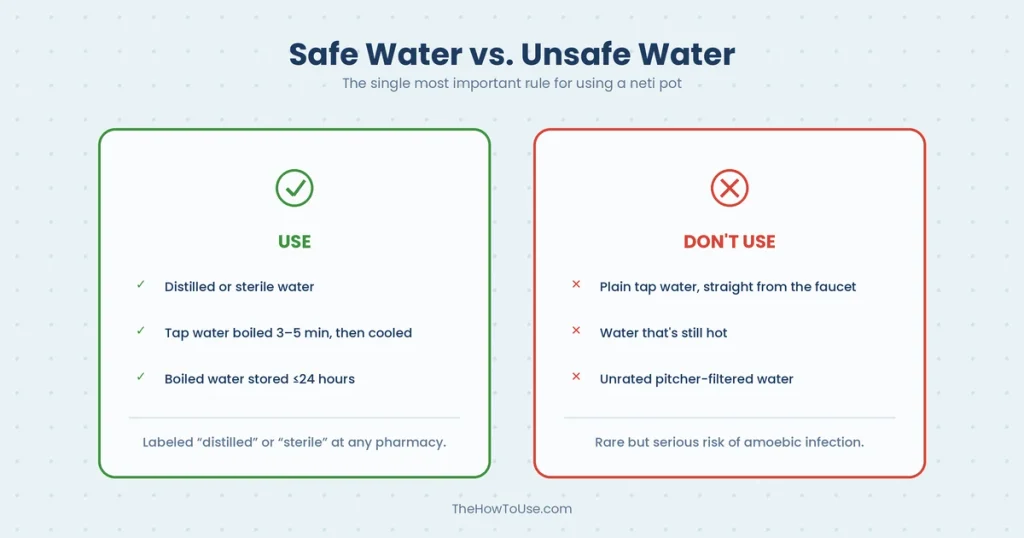
Plain tap water straight from the faucet isn’t sterile. Trace bacteria, and in rare cases, a free-living amoeba called Naegleria fowleri, totally harmless to swallow (your stomach acid handles it, no problem) but genuinely dangerous if it ends up in your nasal passages instead. Can cause a severe, often fatal brain infection. This has actually happened. Real people, real cases, not a hypothetical. Which is exactly why the CDC bothers putting out specific warnings about it.
Fix takes almost no extra effort, for what it’s worth.
Distilled or sterile water, labeled as such, from any pharmacy or grocery store, no searching required. Would you rather use tap water?
Boil it three to five minutes, let it cool to lukewarm first, never pour it in hot. Boiled and cooled water can sit in a clean, closed container, stays usable for about 24 hours. Filtered pitcher water isn’t automatically safe either, not unless that filter’s specifically rated for this kind of organism. So when in doubt, distilled off the shelf is just the easiest, safest call to make.
How to Make Saline Solution for a Neti Pot
Most pots ship with pre-measured packets, and honestly, that’s the easiest route starting out. Nothing to measure yourself.
Want to mix your own? Roughly one teaspoon of non-iodized salt, iodized, irritates the lining, per eight ounces of your properly prepared water from above. Some people toss in a small pinch of baking soda too, making the rinse feel a touch gentler. Stir till the salt’s fully dissolved, double-check it’s lukewarm, not hot, not cold, before it goes anywhere near your nose.
How Often and When to Use a Neti Pot
Occasional congestion or allergies, once or twice a day during a rough stretch is reasonable enough. Taper off once things clear up, rather than just continuing out of habit because it’s already part of your routine.
Timing-wise? No strict rule. Mornings work for a lot of people, clearing out whatever built up overnight. Others prefer evenings, breathing easier before bed. Either’s fine, genuinely, comes down to whatever you’ll actually stick with, which matters more than the exact hour on the clock ever will. Daily use long-term with no specific reason isn’t generally recommended, by the way, since some research suggests it might slightly raise sinus infection risk, washing away some of your nose’s own protective mucus right along with everything else.
How to Use a Neti Pot for a Sinus Infection
Nasal irrigation genuinely helps here. One of the more evidence-backed home remedies out there for sinus congestion generally, not just something that sounds nice on paper and does nothing.
Same technique as above, nothing special for an active infection, though gentler tends to feel better if things are especially inflamed. Works by physically flushing out thickened mucus, reducing some of the swelling making you feel stuffed up, which can ease breathing and may help other treatments, a prescribed spray, say, work better by clearing the path first. Not a replacement for antibiotics if it’s bacterial and actually needs them, to be clear. Just a genuinely useful add-on alongside whatever your doctor’s already got you doing.
How to Use a Neti Pot With a Deviated Septum
Deviated septum, that thin wall between your nostrils sitting off-center, doesn’t rule out a neti pot at all. Usually it just means one side works easier than the other, that’s it.
Technique stays identical, tilt, pour, drain, switch, but the more restricted nostril might drain slower, feel like less is actually getting through. Normal. Not something to force past. Pouring a bit slower, adjusting the tilt slightly, tends to help on the tighter side. One nostril so blocked that basically nothing drains through? Worth mentioning to a doctor, since a significant deviation can sometimes benefit from its own separate treatment entirely.
How to Clean a Neti Pot
A neti pot that doesn’t get cleaned properly between uses can grow the exact bacteria you’re trying to rinse away in the first place. Not optional, in other words, however tempting it is to skip.
After each use, rinse it with the same water type you used for the solution, distilled, sterile, boiled and cooled, never straight from the tap. Let it air-dry completely rather than toweling it off, which can just reintroduce bacteria right back onto it. Every few days, proper wash with warm soapy water, or the dishwasher if it’s labeled safe for that. It’s worth replacing the whole pot every so often too, especially if you spot discoloration or a cloudy film that won’t wash off no matter what.
Benefits and Side Effects of Nasal Irrigation
Nasal irrigation’s got a genuinely solid track record for a handful of specific things. Not entirely without downsides, though, worth knowing upfront rather than finding out the hard way.
Benefit side: reduced congestion, eased allergy symptoms from physically flushing out pollen and dust, sinus infections clearing a bit faster alongside standard treatment. Some people find it helps with the dry, stuffy nose that comes from winter heating indoors, too. Side effects, when they show up, tend to be mild, nasal irritation or a slight burning, usually from water that’s too salty or not quite body temperature.
Occasional ear fullness, generally harmless and temporary. The genuinely serious risk, that amoeba infection covered above, ties entirely back to water quality, not the practice of irrigation itself. Worth saying one more time, since it’s really the whole point of this guide.

Common Neti Pot Mistakes to Avoid
A handful of habits show up constantly with people new to this. Same ones, pretty much every time.
Tap water straight from the faucet, by a wide margin the biggest and most dangerous mistake, already covered in detail above for good reason. Tilting your head wrong, too far forward or not angled sideways enough, usually just means the solution runs straight back out the same nostril instead of actually flushing through.
Water too hot or too cold both cause real discomfort, lukewarm genuinely is the only temperature that feels right here. Skipping the cleaning step lets bacteria build up in the pot over time, quietly. And too much or too little salt, instead of sticking close to that one-teaspoon-per-cup ratio, throws the whole balance off, makes it sting more than it should.
When to See a Doctor
A neti pot’s a genuinely useful tool. Was never meant to replace an actual diagnosis when something’s seriously wrong, though, and that’s worth being upfront about.
Worth checking in with a doctor if symptoms aren’t improving after several days of regular use, if you notice blood in the solution draining out, if a fever shows up alongside your sinus symptoms, or if a severely deviated septum makes the rinse nearly impossible on one side no matter what you try.
And if a sudden severe headache, stiff neck, fever, or confusion shows up after using a neti pot, especially if there’s any chance untreated tap water was involved, that’s urgent. Not wait-and-see. Get medical attention right away, no hesitation.
Watch: How to Use a Neti Pot (Video Guide)
Some people just pick up the tilt-and-pour motion faster watching it once than reading another paragraph about head angles. Fair enough. Mayo Clinic’s got an official demonstration video on sinus rinsing that walks through the whole thing clearly, genuinely worth pairing with this guide if the written steps aren’t quite clicking yet.
Frequently Asked Questions
How do you use a neti pot for beginners?
Mix the saline solution with properly prepared water, tilt your head over a sink, pour into the upper nostril, let it drain out the other side, switch and repeat. Full walkthrough’s in the step-by-step section above.
How often should you use a neti pot?
Once or twice a day during congestion or allergy flare-ups is reasonable. Taper off once things clear up. Daily use indefinitely, for no specific reason, isn’t generally recommended.
Is it better to do a sinus rinse at night or in the morning?
Either works, honestly. Mornings clear out overnight buildup. Evenings help you breathe easier before bed. Whichever you’ll actually stick with matters more than the exact timing.
Is it better to use warm or cold water in a neti pot?
Neither extreme, really. Lukewarm, close to body temperature, is what you’re after. Cold triggers an unpleasant brain-freeze sensation. Hot risks burning the delicate tissue inside your nose.
How can you tell if your sinuses are actually draining during a rinse?
You’ll typically feel the solution flow through and out the opposite nostril within a few seconds, sometimes with mucus along with it. Nothing coming out the other side usually means your head angle needs adjusting, or that one nostril’s just more congested than the other.
What clears up sinus drainage fast?
Nasal irrigation itself is one of the faster, more evidence-backed options, alongside staying hydrated and running a humidifier if the air’s dry. Decongestants can help short-term too, though they’re not meant for more than a few days straight. Anything stubborn, or getting worse instead of better? That’s a conversation for a doctor, not something to keep pushing through alone.
Does a neti pot actually clear sinuses, or is that overstated?
Genuinely helps, and it’s backed by real evidence, not just tradition passed down. Won’t cure an underlying infection on its own, but it measurably reduces congestion and can make other treatments work better by clearing the path first.
Is sinus 100% curable?
Depends heavily on what’s actually causing it. A lot of sinus infections, viral ones especially, clear up completely on their own or with basic treatment, so in that sense, yes, often fully resolved. Chronic sinusitis is different, more something you manage well long-term than permanently erase, since it can flare back up given the right conditions. No single universal answer here, honestly, which is probably the most accurate thing to say about it.
What are the final stages of a sinus infection?
Worth clearing up the premise a little first, sinus infections don’t really move through official numbered stages the way some chronic conditions do. What actually matters is whether symptoms are improving or getting worse. Warning signs something’s turned serious: high fever, severe facial swelling or pain, vision changes, confusion. Those call for urgent medical attention, not more home treatment. The “When to See a Doctor” section above goes into this in more detail.
Is there a printable instruction sheet for using a neti pot?
Not yet on this site, but the five-step sequence up in the step-by-step section is short enough to screenshot, or jot onto a card to keep by the sink for the first few tries.
Key Takeaways
Using a neti pot well really comes down to one thing mattering more than everything else combined: the water. Distilled, sterile, or properly boiled and cooled. Never straight from the tap, no exceptions, ever, full stop. Head back to the home to browse more no-fluff guides across every category
Past that, the technique’s simple enough, mix the solution, tilt your head, pour, let it drain, switch sides, clean the pot properly afterward so it’s ready next time. Once that routine’s dialed in, nasal irrigation genuinely earns its reputation as one of the more useful, low-cost tools for congestion and sinus relief. Precisely because the one real risk involved here is also the single easiest one to avoid entirely.
