
An inhaler is a small handheld device that pushes medication straight into the lungs, and for millions of people dealing with asthma, COPD, or chronic bronchitis, it’s the main line of defense. Here’s the thing nobody really explains well, though: knowing how to use an inhaler properly matters almost as much as having one in the first place. Study after study on inhaler technique keeps finding the same problem — a shocking amount of medicine never even makes it past the throat because of small, fixable mistakes in how people breathe and press. Please checkout our main page to discover more categories like this.
Around the world, the names people reach for most often are Ventolin, ProAir, Proventil, generic salbutamol, Symbicort, Advair, Flovent, and Seretide, plus device styles like the Respimat soft-mist inhaler and the Turbohaler. Different brands, mostly the same basic motion — shake, press, breathe, hold. This guide covers that motion in full, along with spacers, cleaning, the mistakes that quietly rob a dose, and the questions people type into Google most.
Quick note before we get into it: none of this replaces a doctor, a pharmacist, or the little folded leaflet stuffed inside the inhaler box. If technique still feels shaky after reading through this, it genuinely takes five minutes for a doctor to watch someone use theirs and correct it on the spot.
What Is an Inhaler and How Does It Work?
Crack one open (not literally), and there’s a pressurized metal canister sitting inside a plastic shell called an actuator. That canister’s holding medication mixed in with a propellant. Press down, and the propellant shoves a measured dose out through the mouthpiece as a fine mist. Sounds simple. The catch is that mist has to survive the trip past the mouth and throat and actually land somewhere in the airways — and that’s really the whole reason technique ends up mattering so much more than most people assume going in.
Doctors reach for inhalers with a few conditions in particular:
- Asthma — both the “right now” kind of relief and the everyday long-term control
- COPD, short for Chronic Obstructive Pulmonary Disease
- Chronic bronchitis and other airway issues along those same lines
Types of Inhalers (Quick Overview)
Not every inhaler behaves the same way, and this is honestly where a lot of confusion starts — someone learns the technique for one device, then tries to use it on a completely different type.
Metered-Dose Inhaler (MDI)
The classic “puffer.” Canister, plastic actuator, press to release. Ventolin, ProAir, and Proventil all live here, and it’s far and away the most common type prescribed globally. Most of what follows in this guide is built around this one.
Dry Powder Inhaler (DPI)
Diskus and Turbohaler devices fall under this category, and they release powder instead of a spray. The inhale technique basically flips — fast and forceful rather than slow — and a spacer should never go anywhere near one of these.
Soft Mist Inhaler
Respimat is the name most people recognize here. The mist comes out slower than a standard MDI puff, which a lot of older adults find easier to time with a breath.

How to Use an Inhaler for the First Time
A brand-new inhaler needs a bit of prep before its first real use — same goes for one that’s been sitting untouched in a drawer for a week or two. This is called priming, and it clears out air that’s built up inside the canister’s valve so the first actual puff someone takes is a full dose, not a weak, half-there one.
Priming generally goes like this:
- Pop the cap off and shake the inhaler firmly for around five seconds.
- Aim the mouthpiece away from the face and press down once, letting a spray go into open air.
- Do that two to four more times — the exact count depends on the brand, so checking the leaflet is worth the thirty seconds it takes.
Dropped the inhaler? Hasn’t been touched in a week or two? Both of those call for a re-prime, though the exact time window shifts a bit from brand to brand.
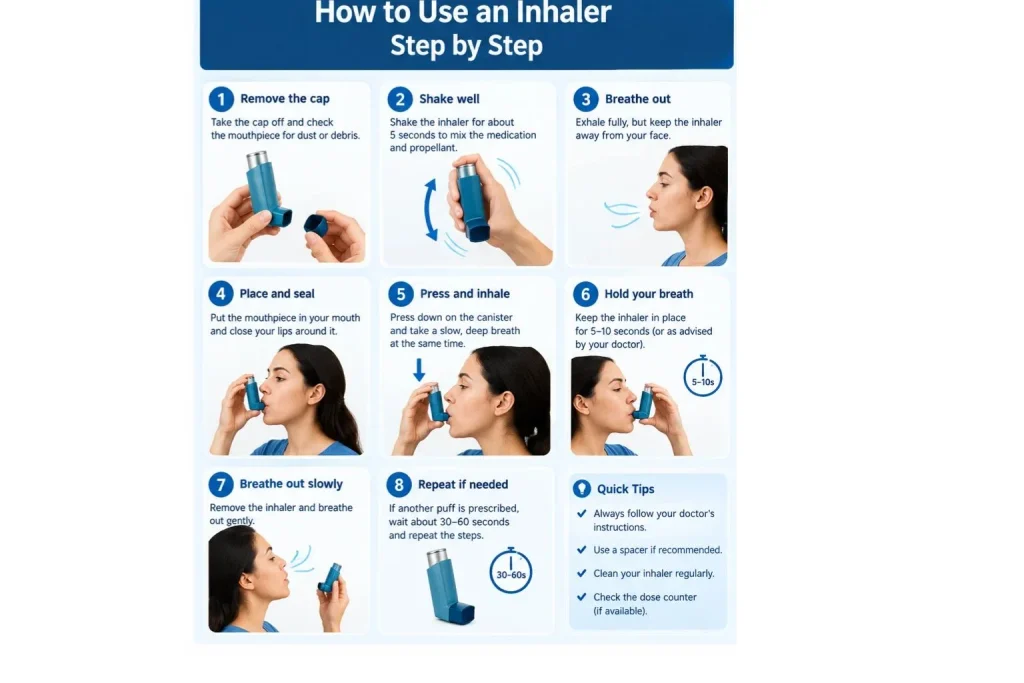
How to Use an Inhaler Correctly: Step-by-Step Instructions (With Pictures)
This is the technique behind most standard metered-dose inhalers, and each step below works well next to a photo or illustration if this ends up being built out visually.
Step 1: Take the cap off and peek inside the mouthpiece.
Takes two seconds, and it catches dust or lint before it becomes a problem.
Step 2: Shake it — properly.
Five seconds or so of shaking blends the medication and propellant together evenly. Skip this, and the dose that comes out can be lopsided.
Step 3: Stand or sit up straight, head tilted back just a touch.
Good posture opens up the airway, which makes pulling in a full, deep breath a lot less of a struggle.
Step 4: Breathe all the way out.
Push as much air out as feels comfortable. Emptier lungs mean there’s more room for that medicated mist to go somewhere useful instead of just bouncing around.
Step 5: Seal those lips around the mouthpiece.
Rest it between the teeth — don’t bite down — and close the lips tight enough that nothing sneaks out the sides.
Step 6: Press and breathe in at the same moment.
This is where nearly everyone stumbles, honestly. The second the inhale starts, press the canister down once, and keep pulling that breath in slow and deep for three to five seconds. Too early, too late — either way, a chunk of the dose just gets stuck in the mouth instead of reaching the lungs.
Step 7: Hold it for about ten seconds.
Pull the inhaler away and hold that breath as long as feels doable — ten seconds is the rough target most guidance lands on. Give the medicine a moment to actually settle instead of getting breathed straight back out.
Step 8: Second puff? Wait first.
If there’s a second dose to take, give it 30 to 60 seconds before running back through steps 2 to 7. Then cap it and set it down.
The short version, for anyone just skimming:
Shake it, breathe out fully, seal the lips, press while inhaling slowly, hold for ten seconds, wait between puffs, cap goes back on.
How to Use an Inhaler With a Spacer (Step-by-Step for Adults)
A spacer’s basically a plastic chamber that sits between the inhaler and the mouth. Rather than that medicated mist firing straight into the mouth and throat, it lingers in the chamber for a second or two — which buys whoever’s using it a little extra time to breathe it in the right way. Result, usually: more medicine reaching the lungs, less of it stuck to the tongue, and often less of that mouth irritation some people get from steroid inhalers.
Spacers tend to be a lifesaver for anyone who just can’t quite nail pressing the canister and inhaling at the same split second — and that’s a lot of people, kids and adults both, if we’re being honest.
Using an inhaler with a spacer, step by step:
- Pull the caps off both the inhaler and the spacer. Shake the inhaler well.
- Slot the inhaler into the spacer’s open end.
- Breathe out fully, away from the spacer itself.
- Put the spacer’s mouthpiece between the teeth and seal the lips around it.
- Press down once — just one dose released into the chamber.
- Now either take one slow, deep breath in, or try “tidal breathing” instead — three to five regular, relaxed breaths in and out through the spacer. Whichever feels more natural is the right one.
- Hold the last breath for about ten seconds, then let it go slowly.
Most adults handling their own inhaler find either method works fine. It really just comes down to whatever’s easier to coordinate on a given day.

How to Use a Dry Powder Inhaler (Different From an MDI)
A dry powder inhaler pretty much flips the standard playbook, which is exactly why jumping between device types without adjusting technique can leave someone shortchanged.
No shaking — shaking a dry powder device can clump the medication together, so that step’s skipped entirely here. A spacer is also off the table; these are built to be inhaled directly, no middleman. After breathing out fully, the lips seal around the mouthpiece, and the inhale needs to be fast and hard, which is basically the opposite of the slow draw used for an MDI. The breath still gets held afterward, same five-to-ten-second range as before.
How to Use an Inhaler for a Cough or Sudden Asthma Symptoms
Rescue inhalers — usually carrying albuterol or salbutamol — exist for exactly this moment: sudden coughing, wheezing, chest tightness, that sinking feeling of not getting enough air. The technique doesn’t change from what’s covered above, but a couple of things are worth flagging specifically here.
Most doctors suggest leaving about a minute between puffs of a rescue inhaler, a bit more breathing room than other medications typically need. And if a cough or breathing trouble isn’t letting up after the number of puffs laid out in someone’s asthma action plan, that’s the moment to get medical help — not to keep pressing the inhaler over and over, hoping it kicks in. Reaching for a rescue inhaler more than usual lately? Worth mentioning to a doctor. It’s often a sign the underlying condition needs a second look.
How to Use a Ventolin Inhaler (Step-by-Step)
Ventolin might be the single most recognized rescue inhaler on the planet, and its technique tracks closely with the standard MDI steps — just with a few brand-specific details tacked on.
Priming a Ventolin inhaler:
First time ever using it, or it’s been sitting for more than two weeks, or it took a fall — any of those call for shaking it well and releasing four test sprays into the air, well clear of the face.
Using a Ventolin inhaler:
- Cap off, shake well.
- Breathe out completely.
- Seal the lips around the mouthpiece, tilt the head back a little.
- Press down firmly while breathing in slowly and deeply.
- Hold for roughly ten seconds, then breathe out.
- Second puff needed? Wait about 30 seconds and repeat.
About the dose counter:
There’s a small window on most Ventolin inhalers that tracks doses left. Once that counter drops to around 20, it’s generally time to swap in a new one — the last handful of puffs can’t always be trusted to deliver the full amount.
Common Inhaler Mistakes That Waste Medicine
Even long-time inhaler users pick up small habits over the years that quietly chip away at how much medicine actually gets where it needs to go.
Skipping the shake is a big one — it leads to an uneven dose, no way around it. Pressing too early or too late trips people up constantly, since the timing needs to line up with the very start of the inhale and nowhere else. Breathing in too fast is another classic — a sharp, quick pull on an MDI sends more medicine straight to the throat than the lungs.
Not holding the breath afterward matters more than people think, too; breathe out right away and a good chunk of that dose never gets the chance to settle in. Then there’s skipping the spacer when one’s actually recommended, which happens a lot with people who genuinely struggle with the press-and-breathe timing. And forgetting to re-prime after the inhaler’s sat around unused for a week or more rounds out the list.
How to Clean and Store an Inhaler
A clogged mouthpiece is one of those quiet reasons an inhaler stops performing the way it used to, and it sneaks up on people because it happens gradually.
Cleaning, roughly once a week:
Pull the metal canister out and set it aside — it should never touch water, full stop. Rinse the plastic mouthpiece and cap under warm running water, shake off whatever’s left, then let it air-dry completely before putting it back together. Overnight drying is the safe bet.
Storing it properly:
Room temperature, away from direct sun and heat. Skip leaving it in a hot car — those pressure swings from heat can mess with the canister more than people realize. And keep that cap on between uses so lint doesn’t build up inside the mouthpiece.
Spacers need their own separate cleaning routine — usually a wash in mild soapy water, then air-drying without wiping the inside. A dry cloth creates static in there, and that static just makes the medication stick to the chamber walls instead of going where it’s supposed to.
When to See a Doctor
An inhaler’s a genuinely useful tool, but it was never meant to replace an ongoing conversation with a doctor about how well things are actually being managed overall. A few signs it’s time to check in:
A rescue inhaler getting used more than it used to. Symptoms that aren’t improving even after the number of puffs from a prescribed action plan. Coordinating the press-and-breathe technique still feeling genuinely hard, even after plenty of practice. And if breathing trouble is severe, getting worse fast, or shows up alongside blue-tinted lips or confusion — that’s an emergency. Not a wait-and-see situation, not something to sleep on.
Frequently Asked Questions
How many puffs of an inhaler is it okay to take?
Comes down to whatever a doctor’s actually prescribed. Rescue inhalers often work out to one or two puffs at a time, roughly a minute apart, but the real number should follow a personalized plan rather than some general rule found online.
How can someone tell their inhaler’s finally empty?
A built-in dose counter makes this a non-issue. Without one, checking the label for total doses against how long it’s been in rotation gives a rough idea — the old trick of floating the canister in water isn’t considered reliable anymore, for what it’s worth.
Is it fine to use an inhaler without a spacer?
Totally fine. Plenty of people manage great technique with no spacer at all. It’s just a helpful extra for anyone who struggles with the press-and-breathe timing, or for younger kids and older adults who need a bit more margin for error.
How often should an inhaler actually get cleaned?
About once a week covers most metered-dose inhalers, though it’s worth a quick check of the specific brand’s instructions since a handful of devices run on their own schedule.
Why does the mouth sometimes taste bitter or feel dry after a puff?
Common, and usually nothing to worry about — steroid-based inhalers cause this more than others. Rinsing with water afterward and using a spacer tends to cut it down.
Do kids use an inhaler differently than adults?
Same core technique, but kids usually need a spacer with a mask attached, since managing the press-and-breathe timing solo is genuinely tough at that age. An adult should be right there supervising, every time.
Key Takeaways
Boiled all the way down, getting the most out of an inhaler comes down to a handful of habits: shake it properly, breathe all the way out first, time that press with the very start of a slow, deep breath, hold for around ten seconds, and grab a spacer if the coordination side of things ever feels off.
Throw in weekly cleaning and a quick re-prime after any stretch of not being used, and most of the mistakes that quietly waste medication just stop happening. Anyone still not confident in their own technique should bring it up with a doctor or pharmacist — watching a real attempt in person catches things no written guide ever could.
If you want to know who we are then please visit our About us page.